Cutting Through Curves: Mastering Elliptical Manway Machining in the Field
-(1)-(1).jpg)
Not all access points are created equal
Elliptical manways are widely used in boilers, pressure vessels, and heat exchangers for a simple reason: they provide larger internal access through limited openings.But when sealing surfaces degrade, their non-round geometry creates one of the most technically demanding challenges in field machining.
Unlike circular flanges, elliptical openings require precision that follows a continuously changing radius. When that geometry is compromised, leaks, repeat gasket failures, and startup delays often follow.
Solving the problem requires more than surface cleanup. It requires restoring the true shape of the sealing face.
Why elliptical manways are uniquely difficult to repair
Circular openings are predictable. Elliptical manways are not. Technicians must account for varying radii across the sealing surface, asymmetrical geometry, and tight tolerances required for proper gasket compression. Access constraints around installed vessels often make the work even more complex.
Over time, corrosion, thermal cycling, and repeated gasket replacements can distort the sealing face. When leaks develop, replacing the gasket alone rarely addresses the root cause. Grinding is often attempted as a quick fix, but manual methods frequently introduce inconsistencies that make sealing performance worse rather than better.
Why grinding makes sealing problems worse
Grinding may appear faster in the moment, but it introduces new risks that often lead to repeat failures.
Manual grinding can create:
-
Uneven sealing surfaces
-
Inconsistent surface finish
-
Localized low spots that become leak paths
-
Poor gasket load distribution
Because elliptical manways rely on even compression across a changing radius, even small geometric errors can prevent a proper seal. For critical systems, precision cannot be optional.
Why removing the vessel is rarely practical
From a theoretical standpoint, shop machining could restore perfect geometry. In practice, removing large pressure vessels or boiler components typically extends outage duration, introduces lifting and transportation risk, and drives costs far beyond the repair itself. Major disassembly may also introduce additional inspection requirements and safety exposure.
For most facilities, field machining is the only realistic solution, but only if it can deliver true geometric accuracy where the equipment is installed.
Machining that follows the curve, not the shortcut
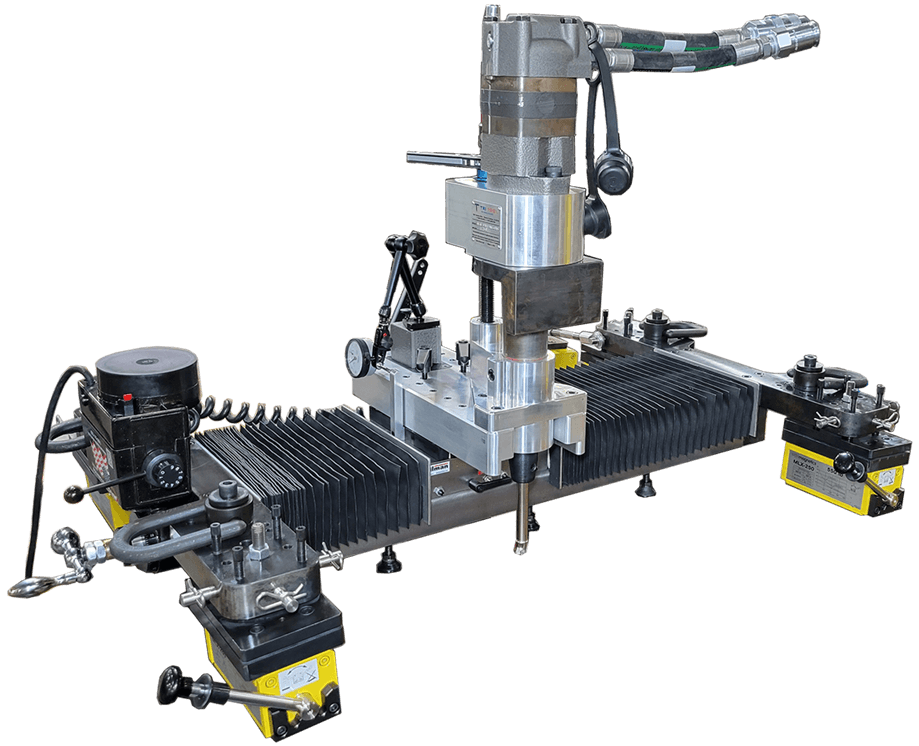
Purpose-built elliptical manway machining systems are designed specifically to respect the true geometry of the opening.
Rather than forcing a circular tool path onto an elliptical surface, the machine:
-
Adapts to the actual manway profile
-
Maintains consistent depth across the sealing face
-
Restores flatness and finish in a controlled pass
-
Produces a gasket surface that seals evenly under pressure
This approach eliminates guesswork and brings repeatable precision back to one of the most failure-prone sealing areas in pressure equipment.
Inside or outside machining flexibility
Real-world environments rarely provide perfect access.
Depending on surrounding equipment and clearance constraints, elliptical manway machining systems can operate:
-
From inside the vessel when external space is limited
-
From outside when internal access is restricted
This flexibility allows field teams to perform accurate repairs without major disassembly, even in congested plant environments.
For outage planners, that adaptability can mean the difference between staying on schedule and falling behind.
Real-world impact: restoring confidence in critical systems
Consider a boiler manway that repeatedly fails leak testing despite multiple gasket replacements.
Each failed test delays startup, increases labor costs, and erodes confidence in the repair process.
By machining the elliptical sealing surface back to specification:
-
Gaskets seat evenly
-
Leak paths are eliminated
-
Inspection passes on the first attempt
-
Startup proceeds without additional delay
What was once a recurring maintenance issue becomes a resolved reliability improvement.
Precision that prevents repeat failures
The true value of elliptical manway machining is not simply stopping today’s leak, it is preventing tomorrow’s outage. By restoring the intended geometry rather than masking symptoms, field teams can reduce recurring maintenance cycles, improve long-term sealing performance, and increase overall equipment reliability.
When geometry is complex, precision must be intentional.
Bringing confidence back to complex sealing surfaces
Elliptical manways will always present unique challenges. Their geometry demands more than approximation.
With purpose-built field machining solutions, teams can restore true sealing performance without removing equipment from service.
For organizations responsible for uptime, safety, and operational certainty, mastering elliptical manway machining is not just a repair tactic… it is a reliability strategy.
FAQs: Elliptical Manway Machining
Why are elliptical manways harder to machine than circular openings?
Elliptical manways have continuously changing radii and asymmetrical geometry, which makes maintaining even gasket compression more challenging.
Can grinding fix an elliptical manway sealing surface?
Grinding often introduces unevenness that worsens sealing performance. Precision machining is typically required to restore proper geometry.
When is field machining preferred over shop repair?
Field machining is preferred when vessels are too large to remove, when outage time is limited, or when transportation risks are too high.
Can elliptical manways be machined from inside the vessel?
Yes. Many purpose-built systems can operate from either inside or outside the vessel depending on access constraints.
What is the main reliability benefit of machining the manway surface?
Restoring the true sealing geometry allows gaskets to compress evenly, eliminating leak paths and reducing repeat maintenance.
What's your next mission?
Our staff and engineers are on the ready. Let Tri Tool get to work.